|
|
| Line 25: |
Line 25: |
| | Not seeing above his shoulder, the naked stars.<br> | | Not seeing above his shoulder, the naked stars.<br> |
| | Each one remembering.’</p><br><br> | | Each one remembering.’</p><br><br> |
| − | 7. Thou shalt perform scrupulously thy feudal duties, if they be not contrary to the laws of God.<br><br>
| + | “Tell me young warriors, how do you want to be remembered? Look up! Now tell me again, what do you see?”<br><br> |
| − | 8. Thou shalt never lie, and shalt remain faithful to thy pledged word.<br><br>
| + | “The eyes of our ancestors.” Another replied with a tone of pride and respect.<br><br> |
| − | 9. Thou shalt be generous, and give largesse to everyone.<br><br>
| + | “MajQa’” He said as he sat back down. The others did the same.<br><br> |
| − | 10. Thou shalt be everywhere and always the champion of the Right and the Good against Injustice and Evil.<br><br>
| + | “Tell us of qeylIS. Did he really form the Empire” One of them asked anxiously.<br><br> |
| − | [[Image:KlingonDeathRitual.jpg|292px|Klingon Death Ritual]]<br><br>[[Image:Rite_of_ascension.jpg|Rite of Ascension]]<br> | + | [[Image:KlingonDeathRitual.jpg|292px|The painting of Kahless the Unforgettable at Boreth (2369)]]<br><br>[[Image:Rite_of_ascension.jpg|Rite of Ascension]]<br> |
| | | | |
| | The first and second commandments deal with piousness and defending the Church respectively. The concept of being devout if not religious is well known to Klingons. Examples are found in Worf’s dedication to the rituals of the Klingon culture and religious ceremonies such as the Heghtay (Klingon death ritual). The spiritual beliefs in places like Sto-Vo-Kor and Gre'tor and the legendary deeds of Kahless all show the spiritual element contained within Klingon society Klingon spiritual life encompasses a host of ceremonies. Ceremonies such as nentay (Rite of Ascension), majQa tay (Rite of Maj'Qa) and the Darghtay (Tea Ceremony) are all examples of Klingon rituals designed to enrich the Klingon spirit. <br><br> | | The first and second commandments deal with piousness and defending the Church respectively. The concept of being devout if not religious is well known to Klingons. Examples are found in Worf’s dedication to the rituals of the Klingon culture and religious ceremonies such as the Heghtay (Klingon death ritual). The spiritual beliefs in places like Sto-Vo-Kor and Gre'tor and the legendary deeds of Kahless all show the spiritual element contained within Klingon society Klingon spiritual life encompasses a host of ceremonies. Ceremonies such as nentay (Rite of Ascension), majQa tay (Rite of Maj'Qa) and the Darghtay (Tea Ceremony) are all examples of Klingon rituals designed to enrich the Klingon spirit. <br><br> |
| | | | |
| − | The Third commandment is a less obvious. The code of chivalry requires knights to protect the weak. In Klingon society weakness is disdained. However, the Klingon proverb -pujwI' HIvlu'chugh quvbe'lu' (there is no honor in attacking the weak) clearly demonstrates the concept of honorable combat and worthy opponents. This protection of the weak can also be seen in Quarks fight with D’Ghor. Quark, challenged by D’Ghor, throws down his Bat’leth and kneels before his attacker. When D’Ghor raises his bat’leth to kill him despite his unarmed stance, Gowron comes to Quark’s aid. Gowron admonishes D’Ghor for this dishonorable act – an act that would kill a weak and unarmed opponent. Although one could argue that Klingons don’t technically protect the weak they do not prey upon the weak either and honor dictates that combat is between worthy opponents.<br><br>
| + | <br><br><br> |
| − | The fourth commandant requires a complete love and devotion to ones country. This is somewhat of a modern interpretation by Gautier. The development of our twentieth century notion of nation states did not develop until well into the fourteenth century. This concept is more akin to the Klingon notion of loyalty to ones family and culture and less to do with a natural devotion to ones country for that concept is relative across time. In the English rites of Chivalry it is specifically stated that knights should maintain loyalty to country, King, honor, freedom, and loyalty to one's friends and those who lay their trust in thee. This virtue is well known in the Klingon Empire. Klingons are extremely loyal not only to the empire but also to their families and to their word. Klingon women are fiercely loyal to their mates. The proverb nIteb Qob qaD jum 'e' chaw'be' Suvwl' (A warrior does not let a friend face danger alone) exemplifies this idea. Loyalty is a virtue that Klingons hold in the highest esteem and those that break that loyalty shame not only themselves but also their family. Klingons equate disloyalty to dishonor and therefore it is not tolerated in Klingon society. <br><br><br><br><br><br>
| + | |
| | |[[Image:Rite_of_ascension.jpg|Rite of Ascension]] [[Image:Tea_ceremony.jpg|292px|Klingon Tea Ceremony]]<br> | | |[[Image:Rite_of_ascension.jpg|Rite of Ascension]] [[Image:Tea_ceremony.jpg|292px|Klingon Tea Ceremony]]<br> |
| | | | |
| Line 59: |
Line 58: |
| | Each of these proverbs expresses the importance of honorable behavior in and off the battlefield. And finally, the most famous of legends about the importance of honor and most specially not lying deals with the story of Kahless and his brother Morath. The story goes that Morath once brought dishonor to his family by telling a lie. Kahless and Morath fought for 12 days and 12 nights. Once again the importance of honor in Klingon society is highlighted and reminds every Klingon that without honor – he is nothing. <br><br> | | Each of these proverbs expresses the importance of honorable behavior in and off the battlefield. And finally, the most famous of legends about the importance of honor and most specially not lying deals with the story of Kahless and his brother Morath. The story goes that Morath once brought dishonor to his family by telling a lie. Kahless and Morath fought for 12 days and 12 nights. Once again the importance of honor in Klingon society is highlighted and reminds every Klingon that without honor – he is nothing. <br><br> |
| | [[Image:Ruustai.jpg|R'uustai ceremony]]<br> | | [[Image:Ruustai.jpg|R'uustai ceremony]]<br> |
| − | Commandment nine “Thou shalt be generous, and give largesse to everyone.” Explains that Knights were more than excellent warriors but also cared for their people and aided the poor. With regards to generosity, A Klingon house is more than an alliance for mutual protection. The head of the house is also responsible for the care of his people. The Klingon legend of Ja’ Duch offers an example of this notion of largesse. “… Ja'Duch, a legendary warrior and hero, said to have founded the first Klingon house. Ja'Duch was a great hunter and fought battles against other tribes to protect his people. He was renowned for his generosity, and for his unusual custom of performing the R'uustai ("bonding") ceremony with the families of his honored enemies, who lost their own protectors.” Another example is found within the legend of Kahless. “It is said that his first act after Molor’s defeat was to return to his family’s farm where he used his bat’leth to harvest all the fields in a single day, ensuring his family would have food to eat and money to support them.” Clearly, Klingon society advocates generosity and largesse to all members of one’s household.<br><br>
| |
| − | The finally commandment is a reminder to always be on the side of good against evil. "Thou shalt be everywhere and always the champion of the Right and the Good against Injustice and Evil.” The best example of Klingon society following this commandment is found in their ideas of rewards after death. For Klingons substitute honorable and dishonorable with "good" or "evil" Klingons that live a dishonorable life will not go to Sto-Vo-Kor. This is an important belief and reminds Klingons that to live dishonorable or to be “evil” in the sense of the Western European sense of the word – one will pay for their failings after death.
| |
| − | <br><br>
| |
| − | The code of chivalry was a set of rules governing behavior during the Middle Ages. It was a way of life that all warriors strove to attain. In many ways the code of chivalry served as a means of social control that allowed the warrior spirit to be directed and tempered. Not all knights attained the title the “flower of chivalry” but most attempted to live by the commandments. The Klingon code of honor is in every way the equivalent of the code of chivalry. Klingons adhere to its teachings and believe they are more than a set of rules, but a set of beliefs that govern all aspects of Klingon culture and society. As pointed out above, for each commandment there is an equivalent in Klingon culture. Although they may be slightly different owning to the particular cultural differences it embodies the same identical theme – a warrior’s code of ethics.
| |
| | </div> | | </div> |
| | <div align=center> | | <div align=center> |
| | <b><u>Sources</u><br> | | <b><u>Sources</u><br> |
| − | http://memory-alpha.org/wiki/Klingon_death_ritual <br> | + | http://en.memory-alpha.org/wiki/Kahless <br> |
| | http://memory-alpha.org/wiki/Rite_of_Ascension <br> | | http://memory-alpha.org/wiki/Rite_of_Ascension <br> |
| | http://memory-alpha.org/wiki/Rite_of_MajQa <br> | | http://memory-alpha.org/wiki/Rite_of_MajQa <br> |
|
|

|
|
|
Culture Basics
OF MYTH & LORE
by Barbara M. Paul
It was a clear night and the stars were shining in all their glory. The fire blazed hot as the young ones arrived for their evening of stories and lessons. Komrek was old, had seen many a battle, and carried the scars to prove it. Now in his declining years when his strength was leaving him he found his heart yearning for the Glory days when he would rush into the battle without fear yelling “Kai Kassai!”. His words striking fear into the enemy. He had one more battle left. How he would meet his death would determine his place in either Sto-Vo-Kor or Gre’Thor.
He sat on a log near the fire and stared into its flames as the young would-be warriors gathered around him. He could see the fire dancing in their eyes as his mind recalled his younger days when he would sit and listen to the old storyteller partake his songs and legends upon him and the others. Now it was his turn to pass on those tales of Glory and Honor to the new generation coming into age.
After a few moments, silence once again claimed the night. Only the crackling and roaring of the flames could be heard. He stood slowly steadying his legs and lifting his bat'leth high toward the naked stars that shown down on them he lifted his heart, closed his eyes and cried out “Kai Kassai!”.
The cry startled the young ones and they began to tremble. He opened his eyes, lowered his bat’leth, and looked at them. “Qam!” (Stand) he said firmly. They all did as he asked quickly and with purpose. “ Now, look up and tell me what you see?”
“I see the stars.” One of them said.
“Those stars will see everything you do or fail to do. A Klingon ballad-poem says:
‘And though I had slain a thousand foes less one,
The thousandth knife found my liver;
The thousandth enemy said to me,
‘Now you shall die, now none shall know’.
And the fool, looking only down, believed this,
Not seeing above his shoulder, the naked stars.
Each one remembering.’
“Tell me young warriors, how do you want to be remembered? Look up! Now tell me again, what do you see?”
“The eyes of our ancestors.” Another replied with a tone of pride and respect.
“MajQa’” He said as he sat back down. The others did the same.
“Tell us of qeylIS. Did he really form the Empire” One of them asked anxiously.

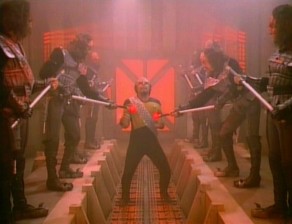
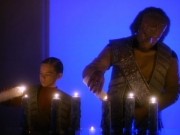
The first and second commandments deal with piousness and defending the Church respectively. The concept of being devout if not religious is well known to Klingons. Examples are found in Worf’s dedication to the rituals of the Klingon culture and religious ceremonies such as the Heghtay (Klingon death ritual). The spiritual beliefs in places like Sto-Vo-Kor and Gre'tor and the legendary deeds of Kahless all show the spiritual element contained within Klingon society Klingon spiritual life encompasses a host of ceremonies. Ceremonies such as nentay (Rite of Ascension), majQa tay (Rite of Maj'Qa) and the Darghtay (Tea Ceremony) are all examples of Klingon rituals designed to enrich the Klingon spirit.
|

The fifth commandment “Thou shalt not recoil before the enemy” is a vital to the code of chivalry and Klingon culture. In a warrior society this is the most important of the commandments. Without courage one cannot have honor -- for the warrior would soon betray his very essence. To die in battle in service to the Empire is the hope of every warrior. Klingon culture is full of examples of the virtue of courage. Heroes such as Kor, Koloth, Kang, Gorkon, Kruge, Gowron, K'mpec, Koord are revered in Klingon society. A son of a Klingon becomes a man when he can hold a blade – emphasizing the courage in the young warrior’s heart. It also symbolizes his willingness to be a worthy member of a House and to carry on the honor of his family. Klingon ceremonies, such as the nenghep (Rite of Ascension) and the Darghtay (Tea Ceremony) show the importance of courage in Klingon culture. Proverbs such as wej Heghchugh vay', SuvtaH SuvwI' (A warrior fights to the death) and may'meyDajvo' Haw'be' tlhIngan (A Klingon does not run away from his battles) illustrates the importance of courage in the Klingon worldview.
The sixth tenet of chivalry is "Thou shalt make war against the infidel without cessation and without mercy” The Church in the eleventh century took great pains in trying to transform the wildness of knights into tempered warriors for Christ. For them this was a manner of social control. There is no direct coalition in Klingon society to this tenet. For this was an attempt by the Church in the Middle Ages to provide some manner of protection to them and divert warrior’s attentions to potential economic and religious rivals. For the Church in the eleventh century -- Crusade was an economic and political move which we are still feeling the affects of today. A similar event could be argued in reference to the Klingon Empire. Prior to 2069 the Empire was plagued by nearly constant internal warfare. There is a marked turn in events after the 2069 when the Klingon High Council turned its attention to space. Like, Western Europe the Klingon Home world turns the warrior spirit loose on the non-Klingon universe thus giving an outlet for the warrior spirit.
Commandment seven highlights the importance of military duty as long as it does not violate the laws of God. For Klingons duty to the Empire and family are paramount (no pun intended). As pointed out above to be disloyal is to be dishonorable. Evidence of Klingon devotion to duty is abundant. A Klingon serves the Empire for life and hopes to die in the service of the Empire. This idea sums up a Klingon’s devotion to his military duties. This sense of duty also runs into ones personal and family relationships. For example the blood oath confirms the idea of duty not only to the Empire but also to ones friends. The only act that would cause a Klingon to turn from his duty is if that duty conflicts with his personal honor. And under such circumstances the request could be deemed unlawful. Worf risks economic and political ruin when he refuses to break his oath to the Federation – when Gowron confronts him and threatens that he and his house will lose everything by not joining him – Worf replies “except my honor”
The eighth commandment "Thou shalt never lie, and shalt remain faithful to thy pledged word” deals with the personal virtues embodied in honor. Honor is the cornerstone of Klingon society and all relationships personal and professional are viewed from a position of honor. It is the guiding principal for the Empire in everything that they do. Axioms include: “word of Honor – an oath that is a stronger bond than all else. One would rather die than break a given word. It is dishonorable to deny anyone their right to do the Honorable thing and the only thing worse than incurring dishonor is refusing to recognize it as such.” Klingon society is filled with examples of the importance of honor in their daily lives and covers every conceivable event. Proverbs such as:
balth potlh law' yIn potlh puS
Honor is more important than life.
quv Hutlh HoHbogh tlhIngan 'ach qabDaj 'angbe'bogh
The Klingon who kills without showing his face has no honor.
batlh qelDI' tlhIngan lumbe'
A Klingon does not postpone a matter of honor.
batlh Heghlu'chugh noDnISbe' vay'
An honorable death requires no vengeance.
pujwI' HIvlu'chugh quvbe'lu'
There is no honor in attacking the weak.
Qu' buSHa'chugh SuvwI', batlhHa' vangchugh, qoj matlhHa'chugh, pagh ghaH SuvwIe'
If a warrior ignores duty, acts dishonorably, or is disloyal, he is nothing.
vangDI' thlIngan SuvwI' ngoy' qorDu'Daj; vangDI' qorDu'Daj ngoy' thlIngan SuvwI'
The family of a Klingon warrior is responsible for his actions, and he is responsible for theirs
Each of these proverbs expresses the importance of honorable behavior in and off the battlefield. And finally, the most famous of legends about the importance of honor and most specially not lying deals with the story of Kahless and his brother Morath. The story goes that Morath once brought dishonor to his family by telling a lie. Kahless and Morath fought for 12 days and 12 nights. Once again the importance of honor in Klingon society is highlighted and reminds every Klingon that without honor – he is nothing.
|


